Every construction project starts with a plan. Schedules are created, resources are allocated,
milestones are agreed upon, weekly planning meetings are held and daily work is coordinated on site.
Despite all this planning, many projects still struggle with delays, rework, unclear responsibilities
and constant firefighting. The problem is rarely a lack of information. Most construction projects
already produce a large amount of data every day.
The real challenge is understanding what all that information is actually telling us.
We have more data than ever before
Modern construction projects generate information from many different planning and control processes.
The master schedule shows long-term progress. Lookahead planning identifies work that should be ready
in the coming weeks. Takt planning shows production flow. Last Planner meetings measure commitment
reliability. Daily planning keeps crews focused on today’s work. Task management tracks individual
actions and responsibilities.
Each of these tools provides valuable information. The problem is that they often exist separately.
A project manager may need to open several reports before forming a clear view of the current situation.
When information is scattered, important signals are easy to miss.
A healthy schedule does not always mean a healthy project
Imagine a project where the Gantt schedule shows only a few late activities. Last week’s PPC looks good.
The Lookahead plan says most upcoming work is ready. Daily meetings are taking place and tasks are being updated.
At first glance, everything appears to be under control.
But beneath the surface, several constraints may have remained unresolved for weeks. Some weekly commitments
may have rolled over again and again. High-priority tasks may still have no responsible person. A few critical
activities may quietly be becoming overdue.
None of these issues alone may look dramatic. Together, they can significantly increase project risk.
A healthy construction project is not the one with the highest score in one report. It is the project where problems are visible early, resolved quickly and prevented from accumulating.
Project Health is more than one KPI
Many organisations rely heavily on a single performance indicator. It may be PPC, schedule progress,
the number of completed tasks or the amount of ready work in the Lookahead plan.
These indicators are useful, but none of them tells the whole story. A project can have a good PPC and
still carry a large backlog of unresolved constraints. A schedule can show acceptable progress while
daily production is struggling. A task list can contain many completed items while the most important
open issues remain untouched.
A healthy construction project balances several planning perspectives at the same time:
- Is the master schedule progressing as planned?
- Is future work ready to start?
- Are weekly commitments being fulfilled?
- Is daily production flowing without interruptions?
- Are important tasks being completed?
- Are old problems actually being resolved?
Only when these questions are viewed together can the overall health of the project be understood.
Project health is a combined view
One KPI can show improvement while another part of the project is deteriorating. A reliable project
health view connects schedule, readiness, commitments, daily execution, production flow and unresolved issues.
The hidden cost of outstanding issues
One of the biggest risks in construction projects is not today’s problem. It is yesterday’s problem
that still exists.
An unresolved design issue. An unfinished weekly assignment. A blocked dependency. A missing approval.
An overdue task without an owner. Each individual issue may seem manageable, but when dozens of unresolved
items accumulate across different planning levels, they reduce the reliability of the entire project.
This growing backlog is often invisible. It does not always appear in one report. It may be spread across
the Gantt schedule, Lookahead constraints, Takt tasks, Last Planner commitments and general task management.
Eventually, unresolved issues appear as delays, productivity losses or rushed decisions on site.
Problems do not disappear when the planning window moves forward. If they remain unresolved, they become project debt.
From reports to project health
Instead of asking project teams to interpret multiple reports, project management software should help
answer three simple questions:
- How healthy is the project?
- Where are the issues?
- What should we solve next?
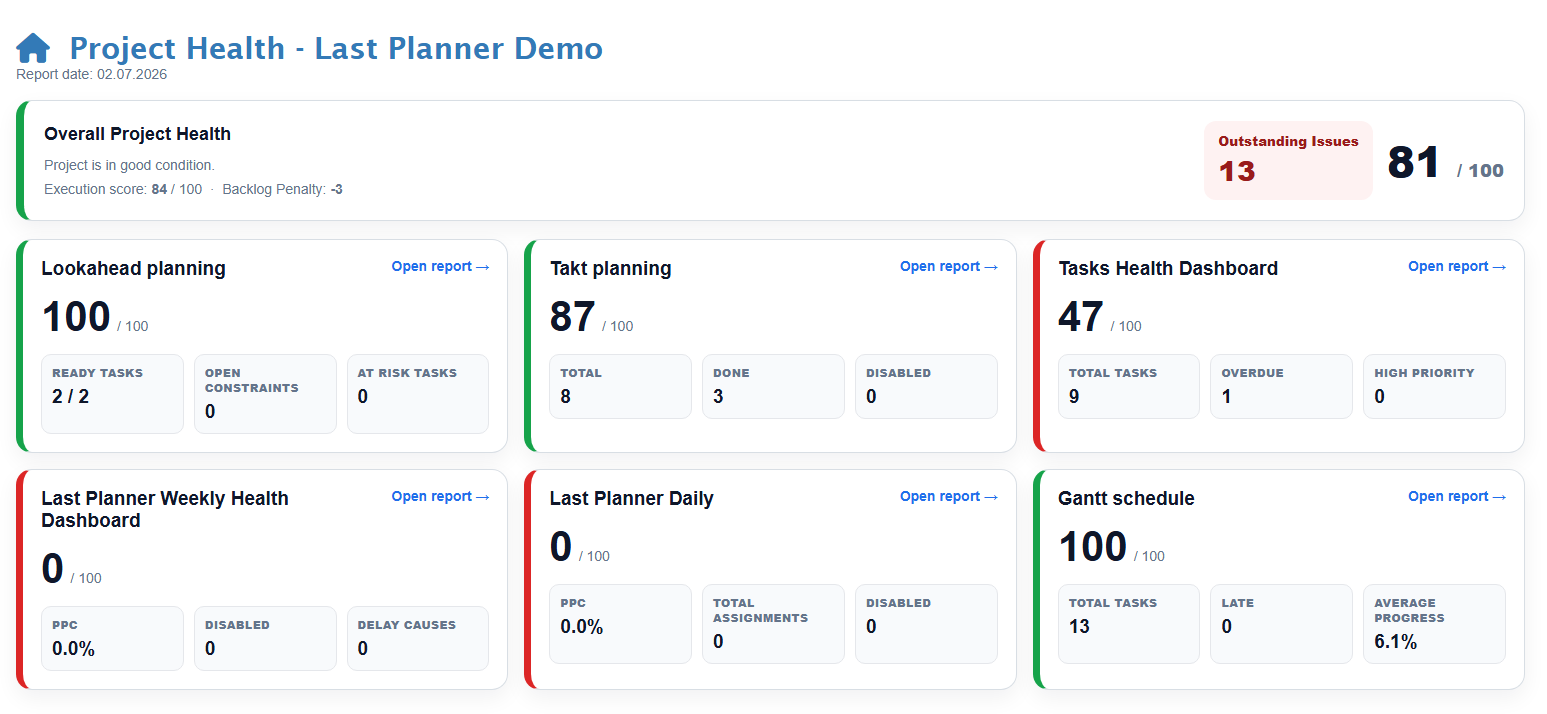
This thinking has led us to develop the concept of Project Health in L-Planner. Rather than replacing
existing reports, Project Health combines information from every planning level into one simple overview.
It brings together information from Gantt scheduling, Lookahead Planning, Takt Planning, Last Planner Daily,
Last Planner Weekly and Task Management. Each module contributes to the overall picture while still allowing
users to drill down into detailed reports when needed.
Outstanding Issues
One of the most important parts of Project Health is the Outstanding Issues view. Instead of hiding unresolved
problems inside separate reports, L-Planner collects them into one list.
Project managers can immediately see which module contains the issue, which task is affected, what its current
status is, why it appears on the list and when it should have been resolved.
Every item links back to the related report. This means the dashboard is not just a summary. It becomes a direct
path from visibility to action.
Make problems easier to resolve
A dashboard should not only show that something is wrong. It should help users understand what the issue is,
where it belongs and where to go next to fix it.
A different way to manage projects
Construction projects will always contain uncertainty. Unexpected events cannot be eliminated, but they can be
identified earlier. The earlier a problem becomes visible, the cheaper it usually is to solve.
This is why project management should focus less on producing more reports and more on helping teams take action.
A dashboard should not simply describe what has happened. It should help project teams decide what to do next.
Project Health changes the discussion from “What does this report say?” to “What needs our attention now?”
What makes a healthy construction project?
A healthy construction project is not perfect. It still has constraints, changes, delays and open tasks.
The difference is that these issues are visible, owned and actively managed.
Healthy projects have reliable schedules, ready work, realistic commitments, clear responsibilities,
active constraint removal and a culture of learning from problems instead of hiding them.
Most importantly, healthy projects do not allow unresolved issues to accumulate unnoticed.
Summary
Project health is more than schedule progress, PPC or task completion. It is the combined understanding of
how the project is performing across all planning levels.
When Gantt scheduling, Lookahead Planning, Takt Planning, Last Planner, daily work and task management are
connected, project teams gain a much clearer view of what is really happening.
The goal is not to create more reports. The goal is to make the right issues visible early enough that teams
can act before small problems become major delays.
Want to see Project Health in action?
L-Planner brings together Gantt scheduling, Lookahead Planning, Takt Planning, Last Planner,
Task Management and Outstanding Issues into one unified Project Health view.
Book a demo